
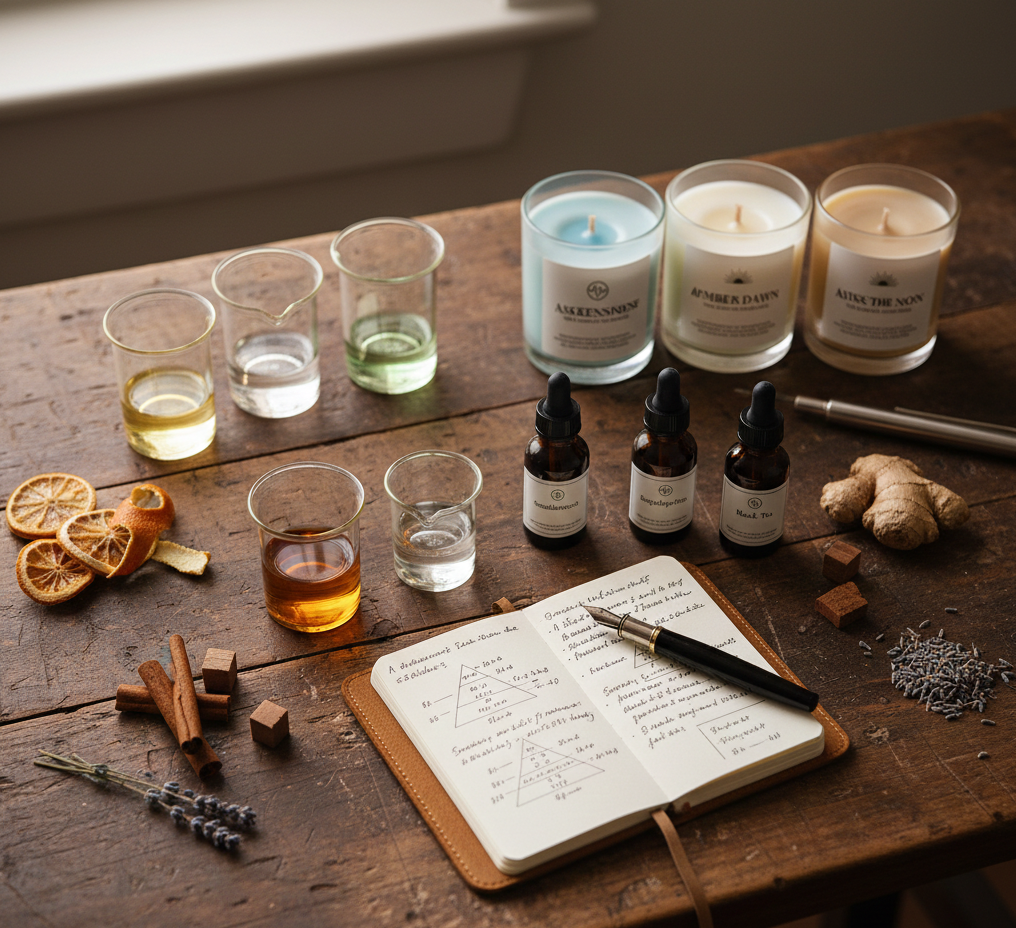
There’s something uniquely captivating about a flickering candle. Beyond the warm glow, it’s the fragrance that truly transforms a space, evokes memories, and sets a mood. But have you ever considered the magic behind that scent? Welcome to the fascinating world of candle alchemy.
Candle alchemy isn’t about turning lead into gold; it’s about the intricate art and science of blending fragrances to create a harmonious and impactful olfactory experience. It’s where creativity meets chemistry, and a little bit of intuition goes a long way.
So, how do you begin to unlock this aromatic magic? Let’s dive into the basics.
1. Understanding Fragrance Families | Your Aromatic Building Blocks
Just like colors on a painter’s palette, fragrances belong to different families, each with its own characteristics. Knowing these families is your first step in successful blending:
-
Citrus: Bright, zesty, uplifting (lemon, bergamot, grapefruit)
-
Floral: Sweet, romantic, powdery (rose, jasmine, lavender)
-
Woody: Earthy, grounding, sophisticated (sandalwood, cedarwood, pine)
-
Spicy: Warm, inviting, stimulating (cinnamon, clove, ginger)
-
Fruity: Sweet, juicy, playful (apple, berry, peach)
-
Herbal/Green: Fresh, clean, invigorating (mint, rosemary, eucalyptus)
-
Gourmand: Delicious, comforting, dessert-like (vanilla, caramel, coffee)
-
Ozonic/Aquatic: Clean, fresh, airy (rain, ocean breeze)
Thinking about my own collection, “Ascension” leans heavily into the herbal/ozonic family with its chilled ozone and eucalyptus, designed to uplift and clarify. On the other hand, “After The Noise” grounds you with its woody (sandalwood, pine) and clean (linen) notes.
2. The Power of the “Note Pyramid” | Top, Middle, and Base
A well-crafted candle fragrance isn’t a flat scent; it’s a journey. This journey is often described using a “note pyramid”:
-
Top Notes: These are the first scents you detect—the initial impression. They are typically light, fresh, and evaporate quickly. Think of the bright grapefruit in “Amber Dawn.”
-
Middle Notes (Heart Notes): These emerge once the top notes fade. They form the “heart” of the fragrance, providing its character and body. These are often floral or spicy. The ginger in “Amber Dawn” and the bergamot in “Gilded Hour” would sit here.
-
Base Notes: These are the longest-lasting and most substantial scents. They provide depth, warmth, and anchor the entire fragrance, often lingering for hours. The sandalwood and black tea in “Gilded Hour” are perfect examples.
When blending, aiming for a balance across these notes creates a complex, evolving scent that truly tells a story.
3. Understanding Scent Throw | The Reach of Your Alchemy
“Scent throw” refers to how well a candle’s fragrance disperses into a room. There are two types:
-
Cold Throw: The scent a candle emits when it’s unlit. This is crucial for initial customer appeal.
-
Hot Throw: The scent released when the candle is burning. This is what truly defines the candle’s performance in a space.
Achieving good hot throw involves careful consideration of your wax type, wick size, and, critically, the fragrance oil’s quality and concentration. High-quality fragrance oils are a candle alchemist’s best friend!
4. The Art of Blending | Where Intuition Meets Experimentation
This is where the real alchemy happens!
-
Start Simple: Begin by blending two compatible fragrances from different families (e.g., a citrus with a woody note, or a floral with a spice).
-
Ratio is Key: Experiment with different proportions. A few drops more or less can completely change the character of your blend.
-
Test, Test, Test: Pour small test candles. Let them cure for at least 1-2 weeks (this allows the fragrance to bind fully with the wax) before burning them to assess the hot throw and overall scent profile.
-
Keep a Journal: Document everything! The fragrance oils used, their ratios, wax type, wick, cure time, and your impressions. This is invaluable for refining your recipes.
Consider the deliberate layering in “Gilded Hour” the warm, grounding sandalwood is lifted by the bright bergamot and deepened by the black tea, creating a sophisticated afternoon experience.
Beyond the Basics | The Path to Mastery
Candle alchemy is a journey of continuous learning. As you experiment, you’ll develop your nose, discover unexpected combinations, and refine your signature style. It’s about creating something more than just a pleasant smell; it’s about crafting an experience, an ambiance, a feeling.
So, grab your fragrance oils, your wax, and your wicks. The world of candle alchemy awaits ready for you to blend, experiment, and illuminate your spaces with your very own aromatic magic.
What scents are you inspired to blend first? Let us know in the comments below!